The Render Pipeline

vertex_data = np.array(
    [
        #   x,    y,    z,   xn,   yn,   zn,    u,    v
        [ 0.5,  0.5,  0.5,  0.0,  0.0,  1.0,  0.0,  0.0],
        [-0.5,  0.5,  0.5,  0.0,  0.0,  1.0,  0.0,  1.0],
        [-0.5, -0.5,  0.5,  0.0,  0.0,  1.0,  1.0,  1.0],
        [ 0.5, -0.5,  0.5,  0.0,  0.0,  1.0,  1.0,  0.0],

        [ 0.5,  0.5,  0.5,  1.0,  0.0,  0.0,  0.0,  0.0],
        [ 0.5, -0.5,  0.5,  1.0,  0.0,  0.0,  0.0,  1.0],
        [ 0.5, -0.5, -0.5,  1.0,  0.0,  0.0,  1.0,  1.0],
        [ 0.5,  0.5, -0.5,  1.0,  0.0,  0.0,  1.0,  0.0],

        [ 0.5,  0.5, -0.5,  0.0,  0.0, -1.0,  0.0,  0.0],
        [ 0.5, -0.5, -0.5,  0.0,  0.0, -1.0,  0.0,  1.0],
        [-0.5, -0.5, -0.5,  0.0,  0.0, -1.0,  1.0,  1.0],
        [-0.5,  0.5, -0.5,  0.0,  0.0, -1.0,  1.0,  0.0],

        [-0.5,  0.5,  0.5, -1.0,  0.0,  0.0,  0.0,  0.0],
        [-0.5,  0.5, -0.5, -1.0,  0.0,  0.0,  0.0,  1.0],
        [-0.5, -0.5, -0.5, -1.0,  0.0,  0.0,  1.0,  1.0],
        [-0.5, -0.5,  0.5, -1.0,  0.0,  0.0,  1.0,  0.0],

        [ 0.5,  0.5,  0.5,  0.0,  1.0,  0.0,  0.0,  0.0],
        [ 0.5,  0.5, -0.5,  0.0,  1.0,  0.0,  0.0,  1.0],
        [-0.5,  0.5, -0.5,  0.0,  1.0,  0.0,  1.0,  1.0],
        [-0.5,  0.5,  0.5,  0.0,  1.0,  0.0,  1.0,  0.0],

        [ 0.5, -0.5,  0.5,  0.0, -1.0,  0.0,  0.0,  0.0],
        [-0.5, -0.5,  0.5,  0.0, -1.0,  0.0,  0.0,  1.0],
        [-0.5, -0.5, -0.5,  0.0, -1.0,  0.0,  1.0,  1.0],
        [ 0.5, -0.5, -0.5,  0.0, -1.0,  0.0,  1.0,  0.0],
    ],
    dtype=np.float32,
)

index_data = np.array(
    [
        0,  1,  2,  0,  2,  3,
        4,  5,  6,  4,  6,  7,
        8,  9, 10,  8, 10, 11,
        12, 13, 14, 12, 14, 15,
        16, 17, 18, 16, 18, 19,
        20, 21, 22, 20, 22, 23,
    ],
    dtype=np.uint32,
)
One thread per Vertex
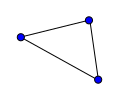
Must produce:
Transition to projective geometry

For all
 .
We often choose
.
We often choose


def look_at(
    eye: ArrayLike, target: ArrayLike, up: ArrayLike
) -> NDArray:
    """
    Convert world coordinates to camera coordinates where the camera
    point in the direction of -z axis.
    """
    eye = np.array(eye, dtype=np.float32)
    target = np.array(target, dtype=np.float32)
    up = np.array(up, dtype=np.float32)
    f = target - eye
    f = f / np.linalg.norm(f)
    s = np.cross(f, up)
    s = s / np.linalg.norm(s)
    u = np.cross(s, f)

    return np.array([[ s[0],  s[1],  s[2], -eye @ s],
                     [ u[0],  u[1],  u[2], -eye @ u],
                     [-f[0], -f[1], -f[2],  eye @ f],
                     [    0,     0,     0,        1]], dtype=np.float32)

 are clipped.
def perspective( fovy_deg: float, aspect: float, near: float, far: float) ) -> NDArray: """ Convert camera coordinates to wgpu clip coordinates where x and y goes from -1.0 to 1.0 and z goes from 0.0 to 1.0. """ angle = fovy_deg * np.pi / 180 yspan = near * np.tan(angle) xspan = yspan * aspect c0r0 = 2 * near / xspan c1r1 = 2 * near / yspan c2r2 = -(far + near) / (far - near) / 2 - 0.5 c3r2 = -far * near / (far - near) return np.array([[c0r0, 0, 0, 0], [ 0, c1r1, 0, 0], [ 0, 0, c2r2, c3r2], [ 0, 0, -1, 0]], dtype=np.float32)

Get data from the Vertex Stage
Compose Primitives Triangles, Lines, Points, …
Divide primitives into Fragments (pixels)
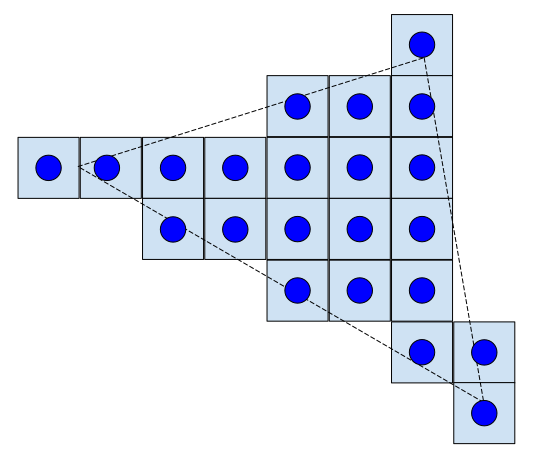
Interpolate data from the Vertex Stage across primitives
Store
 for each pixel
Enables hidden surface removal avoid rendering a fragment that is behind the current rendered fragment at that pixel
Required for 3D rendering pipelines We cannot always render from back to front
Can be sampled in shaders for post-processing effects
from rendercanvas.auto import RenderCanvas, loop
import wgpu

adapter = wgpu.gpu.request_adapter_sync(power_preference="high-performance")
device = adapter.request_device_sync()

canvas = RenderCanvas(
    size=(640, 480), title="WebGPU Example",
    update_mode="continuous", max_fps=60,
)
context = canvas.get_wgpu_context()
render_texture_format = context.get_preferred_format(device.adapter)
context.configure(device=device, format=render_texture_format)

@canvas.request_draw
def draw_frame():
    screen_texture = context.get_current_texture()
    # render in the screen_texture

loop.run()
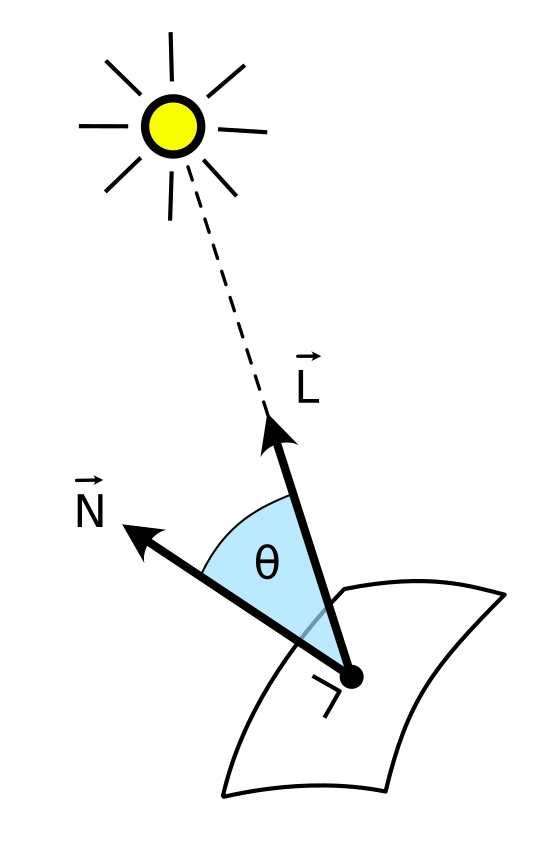
 is the normal vector to the surface.
 is the vector directed towards the light.
These two vectors are normalized.
The diffuse intensity reflected
 is calculated by

where is the diffuse color (i.e. the color of the object).
Colors are
 vectors.

from rendercanvas.auto import RenderCanvas, loop
import wgpu
import numpy as np
import PIL.Image as Image
from primitives import cube
from camera import Camera

class App:
    def __init__(self):
        adapter = wgpu.gpu.request_adapter_sync(power_preference="high-performance")
        self.device = adapter.request_device_sync()

        self.size = (0, 0)

        self.canvas = RenderCanvas(
            size=(640, 480),
            title="WebGPU Example",
            update_mode="continuous",
            max_fps=60,
        )
        self.context = self.canvas.get_wgpu_context()

        render_texture_format = self.context.get_preferred_format(self.device.adapter)
        self.context.configure(device=self.device, format=render_texture_format)

        vertex_data, index_data = cube()

        self.vertex_buffer = self.device.create_buffer_with_data(
            data=vertex_data, usage=wgpu.BufferUsage.VERTEX
        )

        self.index_buffer = self.device.create_buffer_with_data(
            data=index_data, usage=wgpu.BufferUsage.INDEX
        )

        bg_layout = self.device.create_bind_group_layout(
            entries=[
                {
                    "binding": 0,
                    "visibility": wgpu.ShaderStage.VERTEX | wgpu.ShaderStage.FRAGMENT,
                    "buffer": {"type": wgpu.BufferBindingType.uniform},
                },
                {
                    "binding": 1,
                    "visibility": wgpu.ShaderStage.FRAGMENT,
                    "texture": {},
                },
                {
                    "binding": 2,
                    "visibility": wgpu.ShaderStage.FRAGMENT,
                    "sampler": {},
                },
            ]
        )

        p_layout = self.device.create_pipeline_layout(bind_group_layouts=[bg_layout])

        self.render_params_buffer = self.device.create_buffer(
            size=4 * 4 + 2 * 4 * 4 * 4,
            usage=wgpu.BufferUsage.UNIFORM | wgpu.BufferUsage.COPY_DST,
        )

        img = Image.open("./texel_checker.png")
        texture_size = img.size + (1,)
        texture = self.device.create_texture(
            size=texture_size,
            format=wgpu.TextureFormat.rgba8unorm_srgb,
            usage=wgpu.TextureUsage.TEXTURE_BINDING | wgpu.TextureUsage.COPY_DST,
        )
        self.device.queue.write_texture(
            destination={
                "texture": texture,
            },
            data=np.asarray(img),
            data_layout={
                "bytes_per_row": img.size[0] * 4,
            },
            size=texture_size,
        )
        sampler = self.device.create_sampler()

        self.render_params_bind_group = self.device.create_bind_group(
            layout=bg_layout,
            entries=[
                {
                    "binding": 0,
                    "resource": {
                        "buffer": self.render_params_buffer,
                        "offset": 0,
                        "size": self.render_params_buffer.size,
                    },
                },
                {
                    "binding": 1,
                    "resource": texture.create_view(),
                },
                {
                    "binding": 2,
                    "resource": sampler,
                },
            ],
        )

        self.canvas.add_event_handler(
            self.process_event, "pointer_up", "pointer_down", "pointer_move", "wheel"
        )  # type: ignore

        self.camera = Camera(45, 640 / 480, 0.1, 100, 3, np.pi / 4, np.pi / 4)

        vertex_buffer_descriptor = {
            "array_stride": 8 * 4,
            "step_mode": wgpu.VertexStepMode.vertex,
            "attributes": [
                {
                    "format": wgpu.VertexFormat.float32x3,
                    "offset": 0,
                    "shader_location": 0,
                },
                {
                    "format": wgpu.VertexFormat.float32x3,
                    "offset": 3 * 4,
                    "shader_location": 1,
                },
                {
                    "format": wgpu.VertexFormat.float32x2,
                    "offset": 6 * 4,
                    "shader_location": 2,
                },
            ],
        }

        with open("./render.wgsl") as file:
            shader_module = self.device.create_shader_module(code=file.read())

        self.pipeline = self.device.create_render_pipeline(
            layout=p_layout,
            vertex={
                "module": shader_module,
                "entry_point": "vs_main",
                "buffers": [vertex_buffer_descriptor],
            },
            primitive={
                "topology": wgpu.PrimitiveTopology.triangle_list,
                "front_face": wgpu.FrontFace.ccw,
                "cull_mode": wgpu.CullMode.back,
            },
            depth_stencil={
                "format": wgpu.TextureFormat.depth32float,
                "depth_write_enabled": True,
                "depth_compare": wgpu.CompareFunction.less,
            },
            multisample=None,
            fragment={
                "module": shader_module,
                "entry_point": "fs_main",
                "targets": [
                    {
                        "format": render_texture_format,
                        "blend": {
                            "color": {},
                            "alpha": {},
                        },
                    },
                ],
            },
        )

    def process_event(self, event):
        self.camera.process_event(event)

    def loop(self):
        screen_texture: wgpu.GPUTexture = self.context.get_current_texture()  # type: ignore
        size = screen_texture.size
        if size[:2] != self.size:
            self.depth_texture = self.device.create_texture(
                size=size,
                format=wgpu.TextureFormat.depth32float,
                usage=wgpu.TextureUsage.RENDER_ATTACHMENT
                | wgpu.TextureUsage.TEXTURE_BINDING,
            )
            self.size = size[:2]
            self.camera.aspect = size[0] / size[1]

        # light_position must be vec4 for memory alignement
        light_position = np.array([-10, 10, 10, 0], dtype=np.float32)

        proj_matrix, view_matrix = self.camera.get_matrices()

        render_params_data = light_position.tobytes()
        # Must send transpose version of matrices, because GPU expect matrices
        # in column major order
        render_params_data += view_matrix.T.tobytes()
        render_params_data += proj_matrix.T.tobytes()

        self.device.queue.write_buffer(
            buffer=self.render_params_buffer, data=render_params_data, buffer_offset=0
        )

        command_encoder = self.device.create_command_encoder()

        render_pass = command_encoder.begin_render_pass(
            color_attachments=[
                {
                    "view": screen_texture.create_view(),
                    "resolve_target": None,
                    "clear_value": (0.9, 0.9, 0.9, 1.0),
                    "load_op": wgpu.LoadOp.clear,
                    "store_op": wgpu.StoreOp.store,
                }
            ],
            depth_stencil_attachment={
                "view": self.depth_texture.create_view(),
                "depth_clear_value": 1.0,
                "depth_load_op": wgpu.LoadOp.clear,
                "depth_store_op": wgpu.StoreOp.store,
            },
        )

        render_pass.set_pipeline(self.pipeline)
        render_pass.set_vertex_buffer(0, self.vertex_buffer)
        render_pass.set_index_buffer(self.index_buffer, wgpu.IndexFormat.uint32)
        render_pass.set_bind_group(0, self.render_params_bind_group)
        render_pass.draw_indexed(36)
        render_pass.end()

        self.device.queue.submit([command_encoder.finish()])

    def run(self):
        self.canvas.request_draw(self.loop)
        loop.run()

App().run()
struct RenderParams {
    light: vec4<f32>,
    view: mat4x4<f32>,
    proj: mat4x4<f32>,
};

@group(0) @binding(0) var<uniform> params: RenderParams;
@group(0) @binding(1) var texture: texture_2d<f32>;
@group(0) @binding(2) var samplr: sampler;

struct VertexInput {
    @location(0) position: vec3<f32>,
    @location(1) normal: vec3<f32>,
    @location(2) uv: vec2<f32>,
};

struct VertexOutput {
    @builtin(position) clip: vec4<f32>,
    @location(0) position: vec3<f32>,
    @location(1) normal: vec3<f32>,
    @location(2) uv: vec2<f32>,
};

@vertex
fn vs_main(in: VertexInput) -> VertexOutput {
    var out: VertexOutput;
    out.clip = params.proj * params.view * vec4<f32>(in.position, 1.0);
    out.position = in.position;
    out.normal = in.normal;
    out.uv = in.uv;
    return out;
}

@fragment
fn fs_main(in: VertexOutput) -> @location(0) vec4<f32> {
    let light_dir = normalize(params.light.xyz - in.position);
    let shading = clamp(dot(light_dir, normalize(in.normal)), 0.1, 1.0);
    let color = textureSample(texture, samplr, in.uv);
    return vec4<f32>(color.xyz * shading, 1.0);
}
import numpy as np
from numpy.typing import NDArray, ArrayLike
from cgmath import look_at, perspective

class Camera:
    def __init__(
        self,
        fovy_deg: float,
        aspect: float,
        near: float,
        far: float,
        radius: float,
        longitude: float,
        latitude: float,
        target: ArrayLike = [0.0, 0.0, 0.0],
        up: ArrayLike = [0.0, 1.0, 0.0],
    ):
        self.pointer_down = False
        self.last_pointer_pos = np.array([0.0, 0.0])
        self.fovy_deg = fovy_deg
        self.aspect = aspect
        self.near = near
        self.far = far
        self.radius = radius
        self.longitude = longitude
        self.latitude = latitude
        self.target = np.array(target)
        self.up = np.array(up)

    def get_matrices(self) -> tuple[NDArray, NDArray]:
        camera_position = np.array(
            [
                np.cos(self.latitude) * np.cos(self.longitude),
                np.sin(self.latitude),
                np.cos(self.latitude) * np.sin(self.longitude),
            ]
        )

        camera_position = self.target + camera_position * self.radius

        view_matrix = look_at(camera_position, self.target, self.up)
        proj_matrix = perspective(self.fovy_deg, self.aspect, self.near, self.far)

        return proj_matrix, view_matrix

    def process_event(self, event):
        if event["event_type"] == "pointer_down":
            self.pointer_down = True
        elif event["event_type"] == "pointer_up":
            self.pointer_down = False
        elif event["event_type"] == "pointer_move":
            pointer_pos = np.array([event["x"], event["y"]])
            delta = pointer_pos - self.last_pointer_pos
            self.last_pointer_pos = pointer_pos
            if self.pointer_down:
                self.longitude = (self.longitude + delta[0] * 0.01) % (2 * np.pi)
                self.latitude = np.clip(
                    self.latitude + delta[1] * 0.01, -np.pi / 2, np.pi / 2
                )

        elif event["event_type"] == "wheel":
            self.radius = max(0.1, self.radius + event["dy"] * 0.001)