Lab 2 Parallel Computing

Workgroup Memory in WebGPU

Why Use Workgroup Memory?

Benefits

Typical workflow

  1. Threads load data into workgroup memory
  2. Perform collaborative computation
  3. Write results back to global memory

Declaring Workgroup Memory (WGSL)

var<workgroup> sharedData : array<u32, 256>;

Synchronization

Hardware Limits

device.limits["max_compute_workgroup_storage_size"]

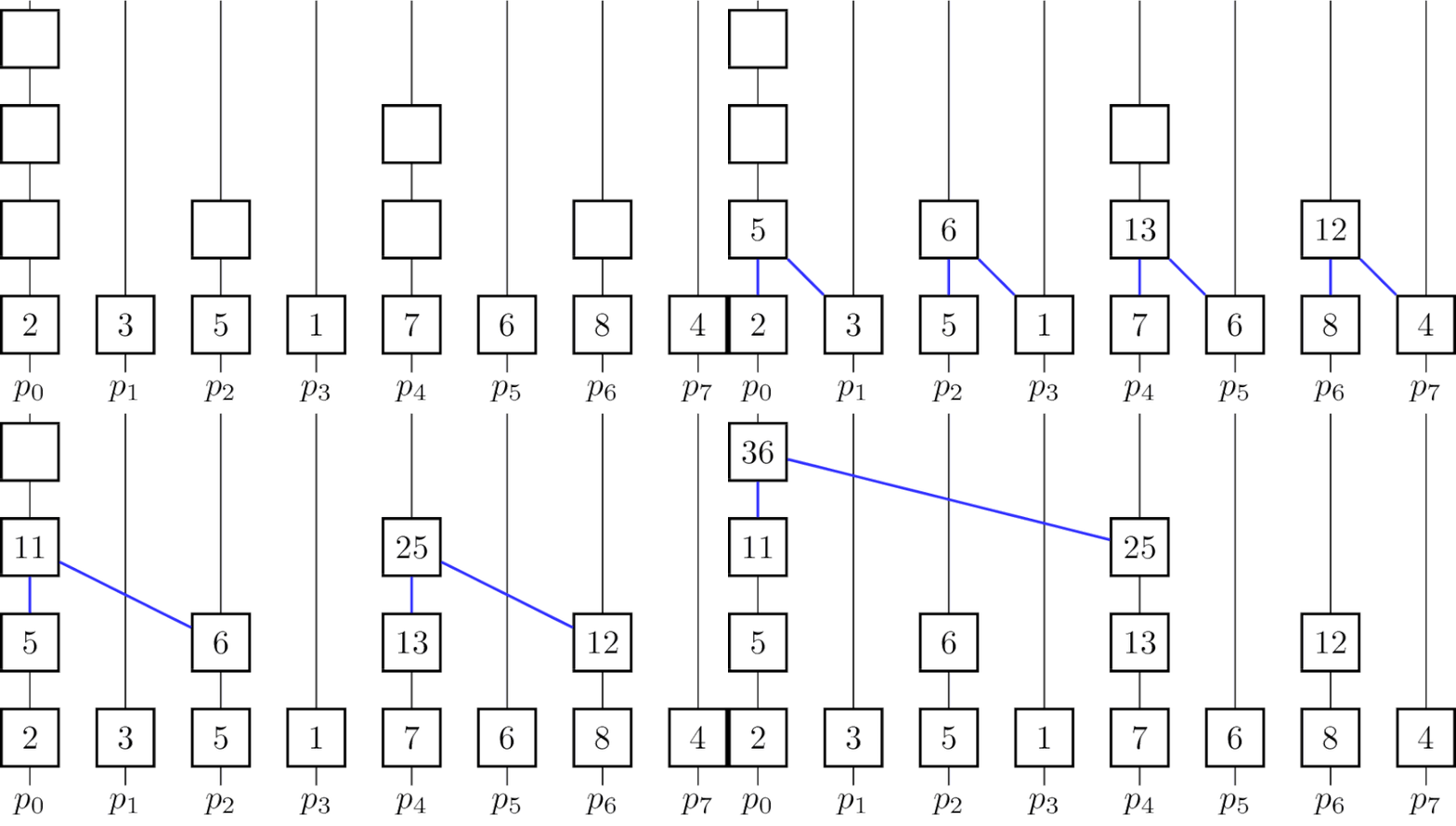
Example: Parallel Sum

Sum in a workgroup (source Wikipedia)

Parallel Sum: Shader

@group(0) @binding(0) var<storage, read> input: array<u32>;
@group(0) @binding(1) var<storage, read_write> partial_sums: array<u32>;

var<workgroup> shared_data: array<u32, 64>;

@compute @workgroup_size(64)
fn main(@builtin(local_invocation_id) local_id: vec3<u32>,
        @builtin(global_invocation_id) global_id: vec3<u32>,
        @builtin(workgroup_id) group_id: vec3<u32>) {

    let idx = global_id.x;
    let local_index = local_id.x;

    // Load data into shared memory
    shared_data[local_index] = input[idx];
    workgroupBarrier();

    // Reduction loop
    var stride = 1u;
    while (stride < 64u) {
        let index = 2u * stride * local_index;
        if (index + stride < 64u) {
            shared_data[index] += shared_data[index + stride];
        }
        workgroupBarrier();
        stride = stride * 2u;
    }

    // Write result of this workgroup
    if (local_index == 0u) {
        partial_sums[group_id.x] = shared_data[0];
    }
}

Partial Sum: Python Code

import numpy as np
import wgpu

# Initialize WebGPU
adapter = wgpu.gpu.request_adapter_sync(
    canvas=None, power_preference="high-performance"
)
device = adapter.request_device_sync()
queue = device.queue

# Create input data
N = 1024  # Must be divisible by workgroup size (e.g., 64)
data = np.arange(1, N + 1, dtype=np.uint32)  # sum = 1024 * 1025 / 2 = 524800

# Create buffer for input data
input_buffer = device.create_buffer_with_data(
    data=data, usage=wgpu.BufferUsage.STORAGE
)

# Create buffer to store partial sums (one per workgroup)
num_groups = N // 64  # workgroup_size = 64
partial_sums_buffer = device.create_buffer(
    size=num_groups * 4,
    usage=wgpu.BufferUsage.STORAGE
    | wgpu.BufferUsage.COPY_SRC,
)

# Shader code: parallel reduction with workgroup shared memory
with open('shader.wgsl') as file:
    shader_code = file.read()

# Create the shader module
shader_module = device.create_shader_module(code=shader_code)

# Bind group layout and pipeline
bgl = device.create_bind_group_layout(
    entries=[
        {
            "binding": 0,
            "visibility": wgpu.ShaderStage.COMPUTE,
            "buffer": {"type": "read-only-storage"},
        },
        {
            "binding": 1,
            "visibility": wgpu.ShaderStage.COMPUTE,
            "buffer": {"type": "storage"},
        },
    ]
)
pipeline_layout = device.create_pipeline_layout(bind_group_layouts=[bgl])

pipeline = device.create_compute_pipeline(
    layout=pipeline_layout,
    compute={"module": shader_module, "entry_point": "main"},
)

# Create bind group
bind_group = device.create_bind_group(
    layout=bgl,
    entries=[
        {"binding": 0, "resource": {"buffer": input_buffer}},
        {"binding": 1, "resource": {"buffer": partial_sums_buffer}},
    ],
)

# Encode and submit commands
encoder = device.create_command_encoder()
pass_enc = encoder.begin_compute_pass()
pass_enc.set_pipeline(pipeline)
pass_enc.set_bind_group(0, bind_group)
pass_enc.dispatch_workgroups(num_groups)
pass_enc.end()
queue.submit([encoder.finish()])

out: memoryview = device.queue.read_buffer(partial_sums_buffer)# type: ignore
partial_sums = np.frombuffer(out.cast("I"), dtype=np.uint32)
total = np.sum(partial_sums) # final sum on CPU

print(f"Partial sums = {partial_sums}")
print(f"Total = {total}")
Choosing the Workgroup Size

  1. Hardware Limits

    • max_compute_workgroup_size_x
    • max_compute_invocations_per_workgroup
    • max_compute_workgroup_storage_size
  2. Warp/Wavefront Alignment

    • GPUs execute threads in fixed-sized groups:
      • NVIDIA: 32 threads (warp)
      • AMD: 64 threads (wavefront)
    • To avoid wasted execution: Choose a size that is a multiple of the warp/wavefront size
  3. Do not exceed shared memory limit

  4. Occupancy and Performance

    • A very large workgroup:
      • May not use all compute units
    • A too small workgroup:
      • Each compute unit has not enough to do
  5. Typical practical ranges:

    • 64 to 256 threads per workgroup
  6. Adjust experimentally for best performance

Exercise

  1. In the parallel sum computation above, the number of active threads is divided by two at each iteration. This is expected, since the amount of remaining work decreases as values are reduced.

    However, in the very first iteration only 32 threads perform useful work to reduce the 64 values in the workgroup. The other 32 threads become idle immediately after copying their values into shared memory.

    In an optimized version, the same 64 threads could process 128 values, increasing the amount of useful work performed per thread.

    Adapt the program to sum 128 values per workgroup of 64 thread.

  2. Computes the maximum value collaboratively

  3. Bonus: Sort a buffer collaboratively (bitonic sort)